Raising Chickens for Eggs: A Complete Beginner's Guide
There’s a particular moment every new chicken keeper remembers: the first morning you lift the nesting box lid and there’s an egg sitting in the straw. Warm, slightly rough-shelled, smaller than you expected. After months of building the coop, sourcing the birds, and second-guessing every decision — you finally have something to show for it.
This guide is for the person about to start that process. It covers the practical decisions you’ll face in your first year: how many birds, what breed, what to build, what it actually costs, and where most beginners go wrong. No “10 reasons to raise chickens” filler — just what you need to know to set up a small flock for eggs and not screw it up.
How many chickens do you need?
For most households, the answer is somewhere between three and six hens. Here’s the math.
A healthy hen in peak production lays four to six eggs per week. That’s at her best — first 18 months or so. A flock of four good layers gives you 16-24 eggs per week, which covers a small family with extras to give away. Six hens push you into 24-36 eggs a week, which means you’re cooking egg recipes you wouldn’t have considered before.
Why not just one or two? Chickens are social. A single chicken will be miserable, noisy, and at higher risk of behavioral problems. Three is a practical minimum — if one dies, the remaining two still have company.
Why not ten? Three reasons. First, every additional bird is more feed, more bedding, more cleaning. Second, predator pressure scales with flock size more than people expect. Third, you’ll have egg drift — production exceeds consumption, eggs accumulate, you forget which dozen is which.
If you live somewhere with a hen limit (many cities cap at four or six), check the ordinance before you buy chicks. While you’re at it, check for rooster bans (almost universal in residential areas) and coop setback requirements (often 10-25 feet from property lines).
Choosing the right breed for eggs
Not all chickens lay the same. There are roughly three categories worth knowing about.
Production hybrids — the ISA Brown, the Golden Comet, the Black Sex Link. These are crossbred for one job: lay a lot of large brown eggs, fast. Expect 280-320 eggs per year for the first two years. They’re docile, calm, and easy to handle. The catch: their reproductive systems wear out faster. By year three or four, production drops sharply and reproductive issues become common.
Heritage layers — the Rhode Island Red, Plymouth Rock, Australorp, Buff Orpington. These were the production chickens of a hundred years ago, bred well before hybrids existed. They lay slightly fewer eggs — call it 200-280 per year — but they lay more consistently across more years, handle winter better, and tend to live longer. Australorps and Rhode Island Reds in particular are forgiving for beginners.
Egg color novelties — Easter Eggers, Marans, Welsummers, Olive Eggers. These lay blue, green, dark chocolate brown, or speckled eggs. They’re fun and they make a beautiful egg basket, but they generally lay less (150-200/year). Pay-back doesn’t matter as much when the eggs themselves are the entertainment.
For a starter flock, the safest play is a mix: two production hybrids for reliable volume, two heritage hens for longevity, and maybe one Easter Egger so you have a blue or green egg in every dozen. You’ll learn how each breed behaves and what you prefer for the next flock.
What to avoid as a beginner: bantams (too small, finicky), Silkies (charming but poor layers), and any “ornamental” breed without “good layer” in the description.
What you need before you bring chickens home
You don’t bring chickens home and figure it out. By the time you have birds, the setup needs to be done. Here’s the minimum.
A coop and a run. The coop is the enclosed sleeping and nesting structure. The run is the secure outdoor area. Standard guidance: 4 square feet of coop floor per bird, 10 square feet of run per bird. Don’t shave these numbers. Crowded chickens fight, get sick, and stop laying.
Nesting boxes. One per three to four hens — they’ll share. Boxes should be roughly 12”×12”×12”, elevated off the floor, with a perch in front and a dark interior.
Roosting bars. Chickens sleep perched, not on the floor. A 2×4 with the wide side up works fine. Plan 8-10 inches of bar per bird. Bars should be higher than the nesting box openings; otherwise they’ll roost in (and poop in) the nesting boxes.
Feeder and waterer. Hanging feeders keep food off the ground. Nipple waterers (the metal-tipped kind) stay cleaner than open trays. Plan one of each per six birds.
Bedding. Pine shavings are the standard. Avoid cedar (the oils are toxic to poultry) and straw (mats down, harbors mites). Sand works well in dry climates.
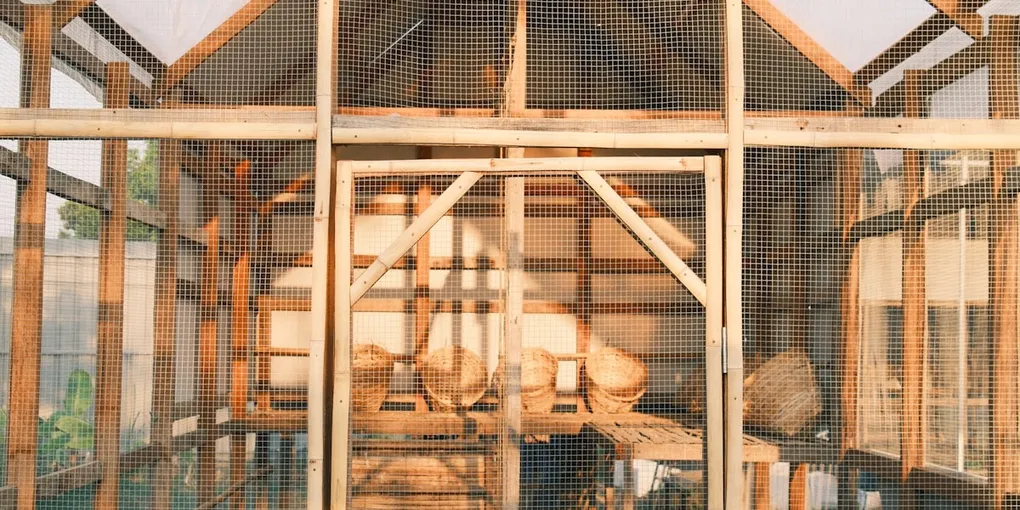
Predator-proofing. This is where most coops fail. Use half-inch hardware cloth, not chicken wire — raccoons rip chicken wire open with their hands. Bury hardware cloth 12 inches deep around the run perimeter, or fold it out into a 12-inch apron, to stop digging predators. Lock the coop door at dusk every night without exception. Skylights need cloth over them; eaves need to be closed.
Budget-wise: expect $400-1500 in startup costs for a four-bird setup, with most of the variation in coop build quality. A used coop on Craigslist can get you started for $200; a nice new one runs $800-2000. DIY plans abound if you’re handy.
Setting up the coop
Coop placement matters more than coop quality. Get this right and the rest follows.
Location. You want morning sun (helps chickens wake up and lay) but afternoon shade in summer. Good drainage — chicken runs flood fast if water collects. Reasonable distance from the house: close enough that you’ll actually do the daily chores, far enough that you don’t hear or smell them through your kitchen window. Twenty-five to fifty feet is usually right.
Ventilation without drafts. Chickens handle cold remarkably well; they handle damp poorly. Their respiratory systems are sensitive to ammonia from their own droppings. Your coop needs vents high up (roof line is ideal) to let humid air escape, and those vents should never be at chicken level where wind would hit roosting birds.
Easy cleaning. You’re going to clean the coop every week or two. Design for it. A solid floor with a removable poop tray under the roost saves enormous amounts of work. Doors big enough to fit a shovel and a 5-gallon bucket through. A linoleum or vinyl floor wipes clean — bare wood absorbs everything.
Egg collection. External nesting box lids — boxes that open from outside the coop — let you collect eggs without entering. This sounds minor until you’ve reached past four hens at 6 a.m. in the rain to grab eggs.
Run protection. A roof on the run (even just a tarp) keeps hawks and owls out. It also keeps the run usable in rain and snow. Fully enclosing the run with hardware cloth is the gold standard if you have any predator pressure.
Feeding chickens
Chicken feeding is simpler than the internet makes it sound. The basics:
Layer feed. A complete pellet or crumble formulated for laying hens. About 16-18% protein, calcium-supplemented for shell formation. This should be 90% of an adult layer’s diet. Don’t switch them to layer feed until they’re at least 18 weeks old or laying — too much calcium too young damages developing kidneys.
Chick feed for chicks. “Starter” (0-8 weeks, ~20% protein) then “grower” (8-18 weeks, ~16% protein). Or use an “all-flock” or “starter/grower” feed that covers both stages. Medicated feed contains amprolium to prevent coccidiosis — useful if your chicks weren’t vaccinated, optional if they were.
Free-choice oyster shell. A small dish of crushed oyster shell available separately from the feed. Hens take what they need for shell strength. Don’t mix it into the feed — over-supplementing calcium causes kidney problems.
Grit. A small dish of insoluble grit (crushed granite). Chickens have no teeth; grit lives in the gizzard and grinds food. They’ll eat what they need.
Water. More important than feed. A laying hen drinks 1-2 cups per day in mild weather, more in summer. Water must be clean. In freezing weather, plan to break ice morning and evening — or use a heated waterer.
Treats and scraps. Chickens will eat almost anything, but “anything” isn’t always good for them. Kitchen scraps in moderation: vegetable trimmings, fruit (no avocado, no citrus, no pits), cooked grains, herbs. Avoid: raw potato or potato peels (solanine), uncooked dry beans, anything moldy, chocolate, salty foods, and anything from the onion family in quantity. Treats should be no more than 10% of their daily intake.
Cost. Plan on 20-25 pounds of feed per bird per month, depending on size and how much they free-range. At $20-25 for a 50-lb bag of layer feed, that’s roughly $10-12 per bird per month at retail. Buy in bulk through a feed store and you can shave that to $7-8 per bird.
Daily care: the actual routine
What does it take to actually keep chickens? Less than you’d think, once it’s set up.
Morning (10 minutes).
- Open the coop door
- Refresh water (or check level)
- Top up the feeder
- Collect any eggs
Evening (5 minutes).
- Head count — make sure everyone made it back into the coop
- Lock the coop door
- Collect any afternoon eggs
Weekly (30-45 minutes).
- Clean out nesting boxes, replace bedding
- Scrape the poop tray under the roost
- Refresh the floor bedding if needed
- Look each bird over briefly — anyone hunched, limping, missing feathers, off their food?
Monthly (1-2 hours).
- Full coop clean: pull all bedding, sweep, refresh
- Top up the run bedding if it’s getting muddy
- Inspect hardware cloth, latches, hinges
- Check for mites or lice — quick look under wings and around the vent
Twice a year (a couple hours).
- Deep clean: scrub coop with poultry-safe disinfectant, dry thoroughly, fresh bedding
- Treat for mites preemptively if you’ve had any signs
Total time: roughly 4-5 hours a month once everything’s running. Less if you’re efficient, more if you enjoy hanging out with the chickens (which, fair warning, you might).
Common health issues
Chickens are generally robust. But a few problems come up enough that you should know the signs.
Mites and lice. Tiny crawly things visible around the vent and under wings. Causes feather loss, restlessness, anemia in bad cases. Treatment: permethrin dust or spray on the bird and in the coop, then repeat in 10 days to catch hatching eggs. Diatomaceous earth helps as prevention but doesn’t treat active infestation reliably.
Egg binding. A hen unable to pass an egg — straining, lethargic, tail down, abdomen swollen. Common in first-year layers or older hens with calcium deficiency. Warm bath, lubricate the vent with vegetable oil, calcium supplement. If you can feel the egg and she’s been struggling more than a few hours, you may need to break it carefully (messy and risky). This is genuinely an emergency.
Sour crop / impacted crop. The crop (a pouch in the throat where food collects) gets blocked or fermented. The hen smells sour, has a squishy or hard lump under the throat, isn’t eating. Massage gently, withhold food for 24 hours, offer water with apple cider vinegar. Long fibrous treats (grass, straw) are the usual culprit.
Bumblefoot. A bacterial infection in the foot, usually from a small cut that gets infected. Looks like a hard black scab on the bottom of the foot. Soak in warm Epsom salt water, remove the scab and the underlying core (this is genuinely surgical and unpleasant), pack with antibiotic ointment, wrap. Easier to prevent: smooth roosts, dry bedding, no jumping from high places.
Respiratory infections. Sneezing, watery eyes, gurgling breath, hunched posture. Often caused by poor ventilation or sudden temperature swings. Mild cases resolve on their own with improved conditions; serious cases (whole flock affected, multiple symptoms) need veterinary intervention or culling.
When to call a vet. Honest answer: most backyard keepers don’t. Avian vets are rare and expensive. For a single hen, the math rarely works. For a flock health concern that could spread, it does. Know your state extension office number — they often have poultry diagnostic services for much less than a vet, and they’re who’d test for serious diseases like avian flu.
Egg production timeline
0-16 weeks. Pullet phase. No eggs. They’re just growing. Plan for this.
18-22 weeks. First eggs. Small, often misshapen, sometimes without a hard shell (“soft shells”). This is normal. Their bodies are still figuring it out. Don’t worry about quality for the first month of laying.
6-18 months. Peak production. Healthy hens lay 4-6 eggs per week in good weather. Expect a brief production dip in late fall as daylight drops below ~14 hours. You can add a light on a timer in the coop to maintain production, or let them rest naturally — both are valid choices.
18-30 months. First molt. Hens drop most of their feathers over 6-12 weeks. Production stops or drastically slows during this time. Don’t panic — it’s normal. They re-feather and resume laying, though slightly fewer eggs than before.
Years 3-4. Production has dropped 20-40%. Hens still lay, just less consistently. Eggs may be larger but fewer.
Years 5+. Most hens are laying 1-2 eggs per week, if any. Some breeds (Australorps, Buff Orpingtons) lay longer; production hybrids often stop entirely.
This brings up the question most beginners avoid: what do you do with a hen who isn’t laying anymore? Honest options are (a) keep her as a pet (chickens can live 8-10 years), (b) cull and process for stew (older bird; not great for roasting), or (c) rehome her if she still has some production left. There’s no wrong answer, but you should have one before you have a coop full of retirees.
Year one: what to actually expect
Here’s a realistic timeline for your first year, assuming you start with chicks in March.
March-April: brooder phase. Day-old chicks need a heated brooder (90-95°F first week, dropping 5°F per week). They live in your house or garage for 4-6 weeks. They’re cute, they make a mess, they smell. Plan for it.
May: move to coop. Chicks have feathers and are about 6 weeks old. They go outside to the coop full-time once nighttime temps are reliably above 50°F.
June-August: growing. They’re awkward teenagers — half-feathered, leggy, exploring. Free-range supervised at first. Watch for predators. They eat less than adults but more than chicks.
September: first eggs. Sometime in late summer or early fall, depending on breed and your latitude, the first egg appears. There will be a comedy of misshapen first eggs, soft shells, eggs laid on the coop floor. Within a month they’ll be using the nesting boxes consistently.
October-December: settling in. Production builds to its peak. You learn each bird’s personality. You learn which one is the boss, which is the bottom of the pecking order, which one always lays in the corner instead of the nesting box.
January-February: first winter. Production drops with shorter days. Plan for fewer eggs. Make sure water doesn’t freeze. The hens are fine in cold — they puff their feathers and tolerate weather you wouldn’t.
Real numbers from four ISA Brown hens in a typical first year: roughly 1,000-1,200 eggs total. That’s ~$300-450 worth of store-bought eggs at current prices.
The financial honest take
This isn’t going to save you money in year one. Let me show the math.
Year-one startup.
- Coop and run: $400-1500 (assuming you build or buy mid-tier)
- Chicks: $5-30 each, so $20-120 for a flock of four
- Brooder setup (heat lamp or plate, tub, feeder, waterer): $80-120
- Feeders, waterers, miscellaneous gear: $50-100
- Bedding for the year: $80-120
- Feed for the year: $250-350
- Total year one: $880-2300
Year-one return. Four hens at peak give you ~80 dozen eggs over the laying portion of the year. Even at premium organic egg prices ($7/dozen), that’s $560 in eggs. At grocery store prices ($4/dozen), $320.
The gap is the cost of doing it yourself. What you’re actually buying with that gap:
- Eggs you know the chickens behind
- Yolks visibly darker, more orange — eat them once and store eggs taste different
- Around 40 lb/year of compost-worthy chicken manure plus bedding
- Pest reduction in the garden
- Something to do every morning besides scrolling
- A small but real step toward producing your own food
If you keep the same hens into year two, the math improves (no chick costs, no brooder setup, feeders already bought). Years 3-4 break even on operating costs. By year five, if you’re still going, you’re producing eggs at materially below market price.
Common beginner mistakes
A few things people consistently get wrong.
Underestimating predators. “There are no foxes in my neighborhood” is usually wrong. Raccoons, opossums, hawks, neighborhood dogs, and stray cats all kill chickens. A coop that’s “probably fine” gets tested at 3 a.m. on month three. Build it like predators are coming. They are.
Building the coop too small. Plans you find online often optimize for footprint, not bird comfort. If the math says four square feet per bird, build six. Crowded chickens are stressed chickens. Stressed chickens get sick, peck each other, and lay less.
Buying too many chicks at once. New flocks have a death rate. Day-old chicks die for reasons you’ll never figure out. Plan for losing one or two of your first batch. Start with one or two more than you actually want, and rehome the surplus if everyone makes it.
Skipping the local ordinance check. This is the one that ends flocks early. Some HOAs ban chickens outright. Some cities require permits or inspections. Some neighbors actually do call the city. Five minutes online before you buy chicks saves you a lot of grief.
Trying to integrate new birds too fast. Adding new hens to an existing flock is genuinely difficult — chickens are aggressive about pecking order. Plan for a 2-4 week integration: keep new birds in a separate enclosure within sight of the flock for a week, then supervised together time, then full integration. Skip this and you’ll have wounded birds.
Romanticizing it. Chickens aren’t pets, and they aren’t a hobby that doesn’t require maintenance. They poop a lot. They have personalities, but those personalities aren’t always charming. You’ll find one dead eventually — sometimes from age, sometimes from a predator, sometimes for no reason at all. Have your eyes open going in.
Where to go from here
A starter flock is a small commitment with an outsized payoff for getting your hands into the food system. The first year is the hardest; after that, the routine is small.
A few natural next steps once you have chickens:
- Composting the coop waste. Bedding-plus-manure is one of the best inputs you can give a compost pile — high nitrogen, high carbon, ready to break down. The composting guide covers how to start a pile that handles this kind of input cleanly.
- A garden. Chickens and gardens reinforce each other. The eggs are good; the compost is better.
- Expanding the flock. Once you’ve gone through a full year, you’ll know whether you want more birds. Most people who keep chickens for a year add more in year two.